
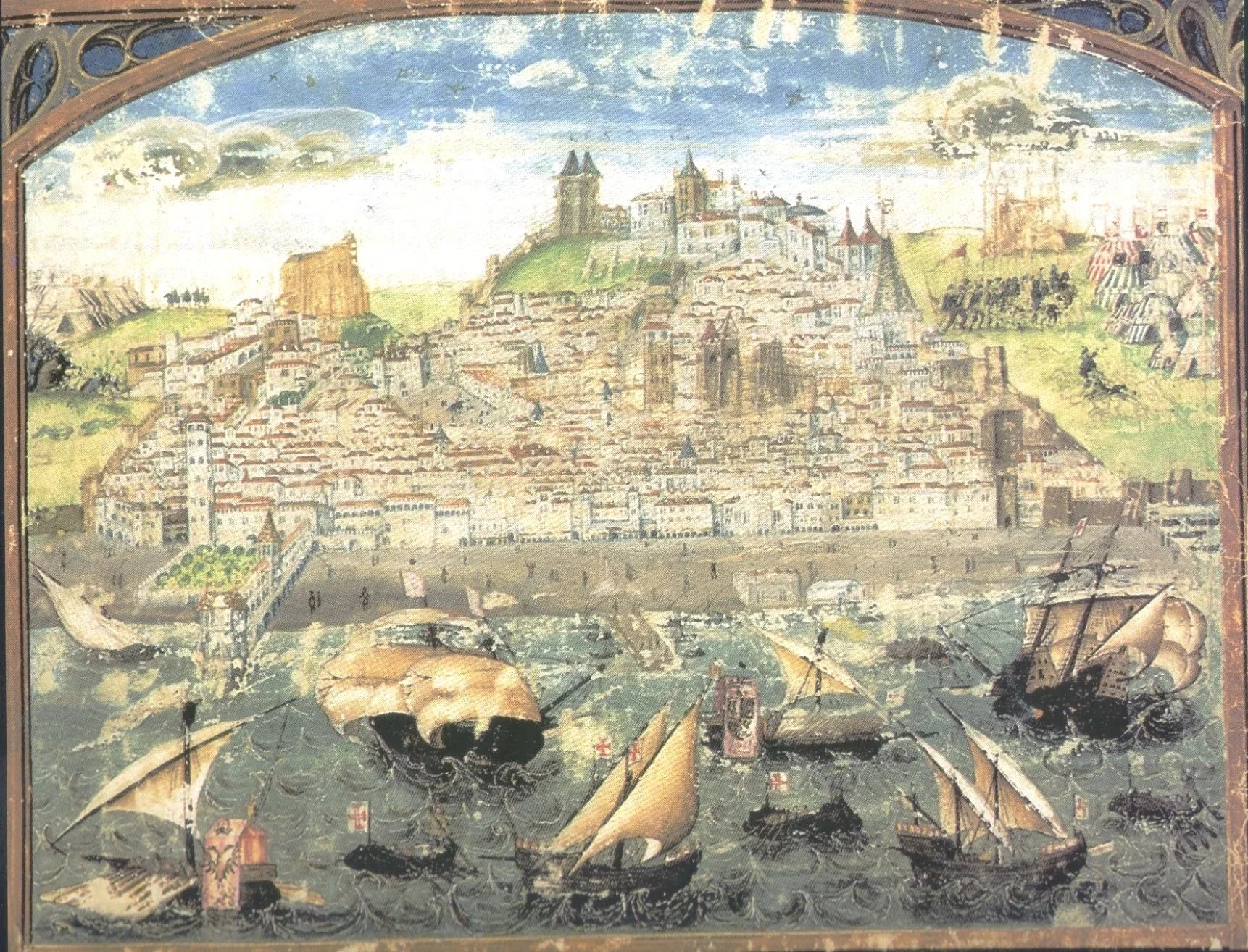
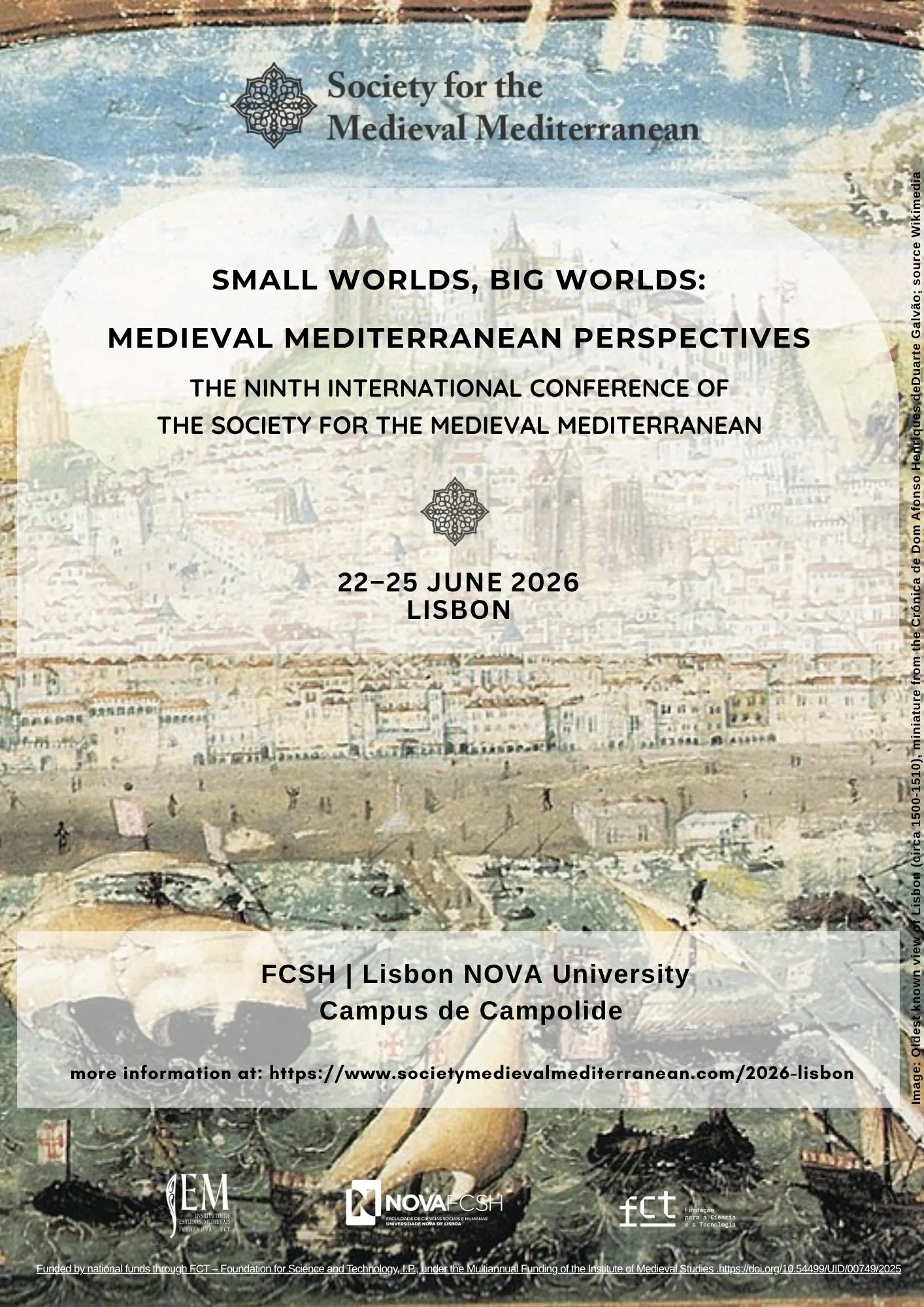
Small Worlds, Big Worlds:
Medieval Mediterranean Perspectives
Instituto de Estudos Medievais (IEM) – NOVA, FCSH
22–25 June, 2026
-
CFP DEADLINE EXTENDED, NOW 15 DECEMBER
The medieval Mediterranean comprised a plethora of different and diverse 'worlds': literally from small farmsteads and cloistered religious communities to large cities and networks of trade; and conceptually from worldviews that comprehended little beyond their immediate locale to those who journeyed widely or studied, thought, and collected knowledge broadly. The variation in scope, scale, nuance and complexity shaped perspectives and phenomena, affected communication and understanding, influenced interactions and exchange, and facilitated or exacerbated peace and conflict.
For its Ninth International Conference, the SMM invites proposals for panels and papers that explore the medieval Mediterranean through the theme 'Small Worlds, Big Worlds: Medieval Mediterranean Perspectives'. This should be interpreted broadly, literally and figuratively, from a range of disciplinary perspectives to consider actual and conceptual 'worlds' in the medieval Mediterranean.
We invite papers that examine the theme from different disciplinary perspectives, including History, Archaeology, Literary Studies, Linguistics, Art History, and Religious Studies/Theology, among others.
We welcome research papers that, through the analysis of diverse types of sources, apply innovative approaches and stimulate debates that will enhance our understanding of ‘worlds’ in and across the medieval Mediterranean.
Topics of the conference could include, but are by no means limited to:
Cross-cultural contacts, interactions, assimilations, tensions and conflicts
Religious and linguistic interactions, e.g., of pilgrims, missionaries, merchants, sailors, travellers and scholars
Diplomatic interactions, e.g., of emissaries, spies, translators and merchants
Military interactions, e.g. of mercenaries and crusaders
Interactions between peoples of the Mediterranean and the wider world, e.g., the Atlantic and Indian Oceans, Asia and Africa
Currents of intellectual thought
Slavery, liberty and captivity
Pirates, renegades and rule-breakers
Migration, movement and settlement
Material evidence of exchange and interactions
Construction and/or deconstruction of ‘identities’
Narrative, visual and material depictions of the everyday and the commonplace
Applicants are encouraged to submit proposals for panels of three 20-minute papers each for 1.5 hour sessions, and should nominate a chair. We will do our best to accommodate applications for individual papers, but panels will be prioritised.
Language: Papers will be delivered in English. However, panel chairs will be allowed to accept discussions in any other language, if able to guarantee translation into English.
Deadline:
Panel proposals in the form of a session title, session abstract (150–200 words), 3 paper titles with short abstracts (100–150 words), and the name of a nominated chair should be submitted to socmedimedit@gmail.com by 15 December 2025.
Individul paper proposals should be in the form of a paper title and short abstract (100–150 words) should be submitted to socmedimedit@gmail.com by 15 December 2025.
-
Click here for the final programme
Note that the conference is strictly in person, and there will be no live streaming of the sessions, except for the keynote speeches, which will be recorded.
-
Early Bird Registration: until March 15 2026 (23:59 UTC+1): €190
Early Bird Registration for SMM members: until March 15 2026 (23:59 UTC+1): £€180
Regular Registration: March 16 – June 7 2026 (23:59 UTC+1): £€210
Regular Registration for SMM members: March 16 – June 7 2026 (23:59 UTC+1): €200
Accepted speakers will have until March 15 2026 to register. After that date, others will be offered their places and will be required to register before April 15 2026.
The final date to register for all other attendees is 29 May 2026.
Join the SMM here to qualify for members' rates
Register here: https://forms.gle/v9NE8KwfnYdf7rj17
-
Tuesday 23 June, 20:00–21:30
Guided visit to Medieval Lisbon. Meeting point: Praça da Figueira, next to the central statue, €15
Wednesday 24 June, 19:00–
Guided Visit and dinner at City Museu (Palácio Pimenta) and its gardens, €50
Thursday 25 June, 10:00–13:00
Half day excursion by boat to river Lisbon, €50
The excursion will travel along riverside Lisbon, guided by researchers who are specialists in medieval Lisbon, highlighting the main points of the medieval city from the perspective of the river.
-
Applications for bursaries are now closed.
15 bursaries are available for PhD students (or ECRs/Independent scholars with limited access to travel funds) who wish to present their research at the conference. The bursaries will cover the costs of registration fees.
-
Keynote Speakers:
Ana Echevarría (Universidad Nacional de Educación a Distancia- Spain)
Facing the Big World: Iberian Perspectives of the Ottoman Lands
Watch this keynote lecture here: https://www.youtube.com/watch?v=YLF7I73DQdE
Abstract:
Medieval authors did not write anthropology as such. However, the need to explore the encounters with far-away civilizations, especially those who were in a process of expansion, forced medieval authors to face customs, landscapes and identities to match their views. This lecture will focus on the knowledge of Ottomans as reflected in the writings of Iberian writers belonging to different social groups in the kingdom of Castile in the fifteenth century: the royal entourage, Franciscans, and Mudejars. Their views portray the Turks as nomadic people first and great conquerors of Asia later, and the Ottomans as the emerging strong dynasty of Muslim rulers.
Short bio:
Ana Echevarria is Professor of Medieval History at the Universidad Nacional de Educación a Distancia in Madrid (Spain). She holds a PhD from the University of Edinburgh. She was one of the PIs of the project “Christian Society under Muslim Rule: Canon Collections from Medieval Spain” funded by the Gerda Henkel Foundation and is now working on a multimedia book “Religious Minorities and Specialized Labour”. She is also a member of the Marie Curie Action CIRCE - “InClusive valorIsation model foR Controversial cultural hEritage in the Mediterranean Harbours and beyond” (2025-2029).
Dan Smail (Harvard University)
Practices of Slavery in Mediterranean Europe, 1250-1500
Watch this keynote lecture here: https://www.youtube.com/watch?v=yhBA9MA1Fq0
Abstract:
Everywhere in late medieval Mediterranean Europe, it was possible, at least in theory, to purchase and hold an enslaved individual. The traffic in slaves began a noteworthy period of growth in the thirteenth century. In the second half of the fourteenth, the rise of the Black Sea trade led to a significant acceleration. Yet the practice of slavery was never uniform across the region. In some cities, as much as 15 percent of the population may have been enslaved. Elsewhere, the presence of enslaved individuals is scarcely detectable. The significant variation in the degree to which slavery implanted itself in the cities and towns of Mediterranean Europe is a historical phenomenon in search of explanation. Through a survey of practices of slavery in Marseille, a city located in the borderlands of the practice, this lecture seeks to frame a set of questions that could guide research in coming decades.
Short bio:
Daniel Lord Smail is Frank B. Baird, Jr. Professor of History at Harvard University, where he works on the History and Anthropology of Mediterranean Europe between 1100 and 1600 and on deep human history. In recent work, he has been using household inventories from the period to understand transformations in material culture. His most recent book is Magdalena Coline: A Life Beyond Mediterranean Slavery (Princeton University Press, 2025).
-
The conference will be hosted in the Lisbon Nova University, Colégio Almada Negreiros (Campus de Campolide, 1099-085 Lisboa).
Specific details will be provided in the final programme.
-
Within the Campus area, conference delegates can use the University wireless network. Those affiliated with institutions that participate in the Eduroam network may use their own accounts.
June in Lisbon is generally warm and sunny, with long daylight hours and very little rainfall. Average daytime temperatures range from 22°C to 28°C (72°F to 82°F), while evenings are mild and comfortable. The skies are usually clear, and a light breeze from the Atlantic helps keep the heat pleasant.
-
The conference will be hosted in the the Lisbon Nova University, Campus Campolide, Colégio Almada Negreiro (Campus de, 1099-085 Lisboa). The city of Lisbon offers a huge variety of accommodation. There are several hotels near the campus.
Some of the nearest hotels are listed below:
Distance - 800 metres
Distance - 1000 metres
Distance - 1200 metres
Distance - 1300 metres
-
Lisbon has an international airport, which is connected to the city by buses and the subway. To reach the Campolide Campus by subway, you should exit at São Sebastião station, which is on the red line and directly connected to the airport station.
For more information about the subway map see: https://www.metrolisboa.pt/wp-content/uploads/2022/06/Metropolitano-De_Lisboa_Diagrama-da-Rede_maio2022.pdf?utm_source=chatgpt.com
-
Luís Filipe Oliveira
Catarina Tente
Marta Capote
-